Hydrostatic testing guide
Fire extinguisher hydrostatic test: intervals by type, DOT cylinder rules and test labels
Last updated
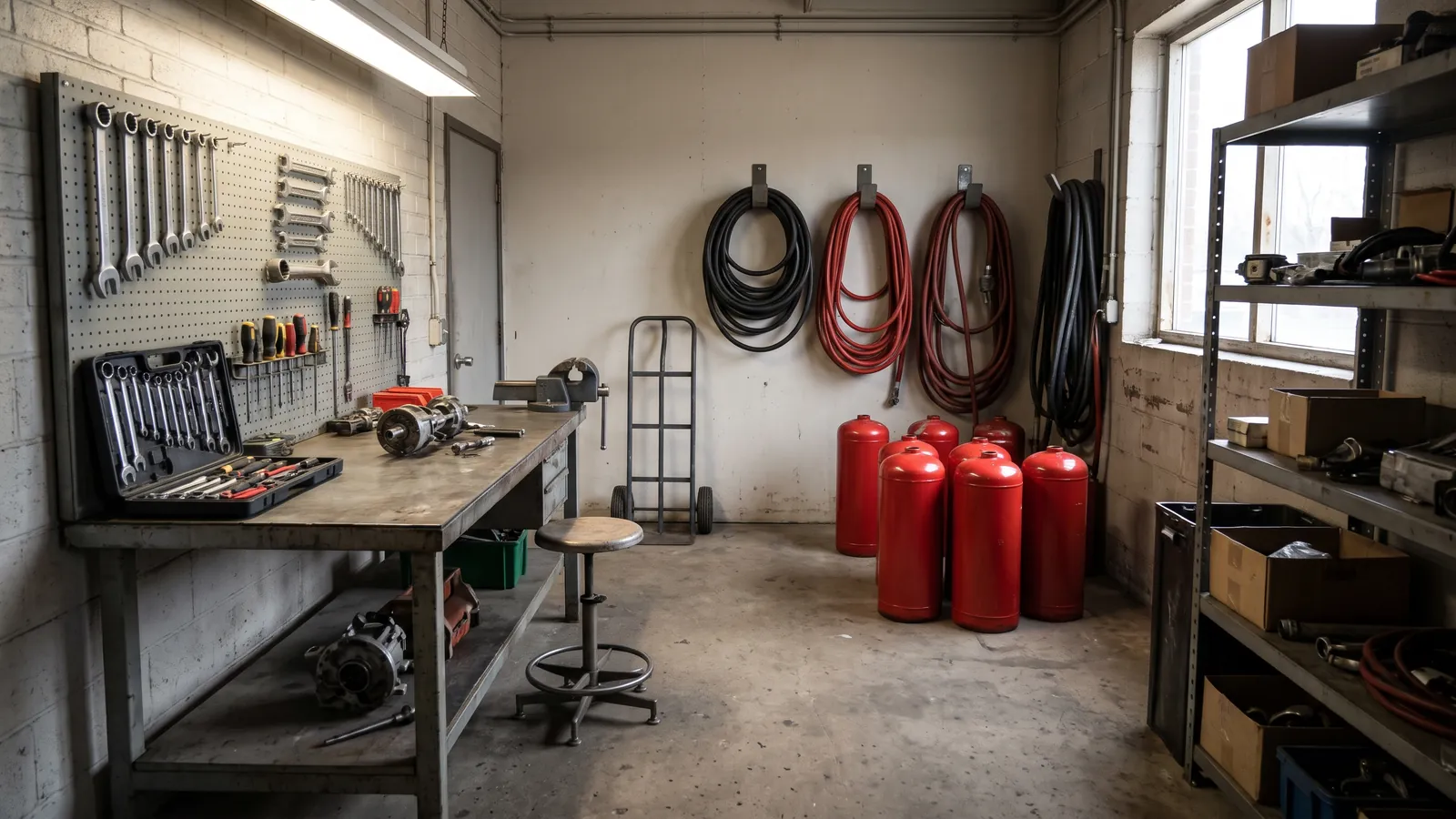
A hydrostatic test pressurizes an extinguisher shell with water to prove it will not rupture in service. The Minnesota Department of Health, summarizing NFPA 10, describes it as pressure testing "to verify its strength against rupture." Three sets of rules meet at the test bench: OSHA 29 CFR 1910.157(f) for extinguishers an employer provides, NFPA 10 Chapter 8 as adopted by your state, and, for cylinders built to a DOT specification, the requalification rules in 49 CFR Part 180. This page goes deeper than our fire extinguisher inspection requirements page.
Hydrostatic test intervals by extinguisher type
OSHA Table L-1 in 1910.157 is the federal list. NFPA 10 sets its intervals in Table 8.3.1; the NFPA column below is the 2010 edition as summarized by the Minnesota Department of Health, which lists only common types. The edition your state enforces may differ (see our fire extinguisher inspection requirements page), so confirm it before relying on a table number.
| Extinguisher type | OSHA Table L-1 | NFPA 10 (2010, MDH summary) | Notes |
|---|---|---|---|
| Stored pressure water and/or antifreeze | 5 | 5 (pressurized water) | Low pressure cylinder, recorded on a label |
| Water mist | Not listed | 5 | |
| Wet chemical (Class K) | Not listed | 5 | Low pressure cylinder, recorded on a label |
| Aqueous Film Forming foam (AFFF) | 5 | Not in the MDH summary | |
| Loaded stream | 5 | Not in the MDH summary | |
| Carbon dioxide | 5 | 5 | High pressure cylinder, stamped. OSHA test pressure is 5/3 of the stamped service pressure |
| Dry chemical with stainless steel shell | 5 | 5 | |
| Dry chemical, stored pressure, mild steel, brazed brass or aluminum shell | 12 | 12 (dry chemical) | Low pressure cylinder, recorded on a label. Needs the 6 year internal examination between tests |
| Dry chemical, cartridge or cylinder operated, mild steel shell | 12 | 12 (dry chemical) | |
| Dry powder, cartridge or cylinder operated, mild steel shell | 12 | Not in the MDH summary | |
| Halon 1211 | 12 | Not in the MDH summary | Tested at factory test pressure, not over 2 times service pressure |
| Halon 1301 | 12 | Not in the MDH summary | |
| Nitrogen or CO2 cylinders on wheeled extinguishers | 5, or 10 for qualifying nitrogen cylinders ((f)(10)) | Not in the MDH summary | Tested at 5/3 of the stamped service pressure. Nitrogen cylinders that comply with 49 CFR 173.34(e)(15) may go 10 years |
Two notes on the table. Wet chemical and water mist do not appear in Table L-1; the 5 year figure for them comes from the NFPA 10 summary. And nonrechargeable stored pressure units (disposable dry chemical) are not hydro tested at all: NFPA 10 (2010, 7.3.1.2.1.3) removes them from service 12 years after the date of manufacture.
Intervals are a maximum, not the only trigger. Under 1910.157(f)(4) an extinguisher is hydro tested whenever it shows new evidence of corrosion or mechanical injury, except under the conditions listed in (f)(2).
Test pressures, hose assemblies and equipment
OSHA 1910.157(f) sets out the test itself, not just the schedule. Before any hydro test the cylinder gets an internal examination as well as an external visual examination ((f)(3)). The rest of the paragraph covers pressures and equipment:
- Stored pressure and Halon 1211 units: tested at the factory test pressure, not to exceed two times the service pressure ((f)(11)).
- Carbon dioxide extinguishers, and nitrogen or CO2 cylinders on wheeled units: every 5 years at 5/3 of the service pressure stamped into the cylinder ((f)(10)).
- Hose assemblies with a shut-off nozzle at the discharge end are tested on the same interval as the extinguisher ((f)(5)): CO2 hose at 1,250 psi, inside a protective cage, and dry chemical or dry powder hose at 300 psi ((f)(6), (f)(7), (f)(9)). A hose that passes needs no recording or stamping ((f)(8)).
- "Air or gas pressure may not be used for hydrostatic testing" ((f)(13)).
- Compressed gas cylinders are tested on water jacket equipment with an expansion indicator accurate to within one percent of total expansion or 0.1 mL ((f)(15)(i)).
DOT rules for extinguisher cylinders: 49 CFR Part 180
Cylinders made to a DOT specification are also governed by the hazardous materials regulations. 49 CFR 173.309(a) authorizes specification 3A, 3AA, 3E, 3AL, 4B, 4BA, 4B240ET and 4BW cylinders as fire extinguishers on conditions, including that the extinguisher "may not contain more than 30% carbon dioxide by volume or any other corrosive extinguishing agent" ((a)(3)). Requalification of those cylinders is set by 49 CFR 180.209.
| DOT specification | Test method | Minimum test pressure | Requalification |
|---|---|---|---|
| 4B, 4BA, 4B240ET, 4BW, water capacity 12 lb (5.44 kg) or less | Water jacket, direct expansion or proof pressure | 2 times service pressure | By 12 years after the original test date, then every 12 years |
| 4B, 4BA, 4B240ET, 4BW, over 12 lb | Water jacket or direct expansion | 2 times service pressure | By 12 years, then every 12 years |
| 4B, 4BA, 4B240ET, 4BW, over 12 lb | Proof pressure | 2 times service pressure | By 12 years, then every 7 years |
| 3A, 3AA, 3AL | Water jacket or direct expansion | 5/3 times service pressure | 12 years after the original test date, then every 12 years |
Under the volumetric methods, permanent expansion may not exceed 10 percent of total expansion; under proof pressure, the cylinder is examined at test pressure and removed from service if a leak or defect is found.
Carbon dioxide extinguishers are the exception to watch. Paragraph 180.209(j) applies only to cylinders used "in conformance with § 173.309(a)," and 173.309(a)(3) caps carbon dioxide at 30 percent by volume. Our reading is that a CO2 extinguisher cylinder therefore does not get the 12 year fire extinguisher period. OSHA (f)(10) and the NFPA 10 summary both put CO2 extinguishers on a 5 year test.
Who may perform the test
OSHA requires hydro testing "by trained persons with suitable testing equipment and facilities" (1910.157(f)(1)). The NFPA 10 summary adds that the work needs special training and the manufacturer's service manual. For DOT cylinders the bar is higher: under 49 CFR 180.205(b), no one may mark a cylinder with a requalifier identification number (RIN) and test date, or represent that it was requalified, without a current DOT approval issued under 49 CFR Part 107, Subpart I. The requalifier also keeps the test records required by 180.215 at each location where it tests or marks cylinders.
States can add a license layer. Texas, for example, requires "a separate Type C registration" to engage in the business of hydrostatic testing DOT specification extinguisher cylinders (28 TAC 34.510(c)). For DOT specification extinguisher maintenance, 34.510(e)(10) calls for either a written notice naming the firm that will perform the hydrostatic test, or a current Type C registration plus verification of registration through the U.S. DOT.
The test label or stamp, and what it must show
- Low pressure cylinders (dry chemical, wet chemical, pressurized water) that pass: a metallic or similarly durable weatherproof label, at least 2 by 3.5 inches, applied by a heatless process, showing the month and year of the test by perforation (hand punch), the test pressure, the initials or name of the tester and the name of their company (NFPA 10, 2010, 8.7.2 and 8.7.2.2, per MDH).
- High pressure cylinders (CO2) that pass: stamped with the tester's identification number and the month and year of the test (NFPA 10, 2010, 8.7.3, per MDH).
- DOT cylinders: the RIN set in a square pattern between the month and year of requalification, first character upper left, second upper right, third lower right, fourth lower left (49 CFR 180.213(d)). A cylinder used as a fire extinguisher under 180.209(j) may carry this marking on a pressure sensitive label (180.213(c)(1)).
- OSHA record: a certification record with the test date, the tester's signature and the serial number or other identifier, kept until the next retest or until the unit leaves service (1910.157(f)(16)).
Condemning a cylinder
The Table L-1 schedule does not apply when the shell has been repaired by soldering, welding, brazing or patching compound, has damaged threads, has pitting corrosion (including under a removable nameplate), has been burned in a fire, or held calcium chloride agent in a stainless steel shell ((f)(2)), and a shell that fails or is unfit for testing is "removed from service and from the workplace" ((f)(14)). For DOT cylinders, 49 CFR 180.205(j) makes condemnation mandatory when:
- the cylinder meets a condemnation condition in the visual inspection rules;
- it leaks through its wall;
- cracking is likely to weaken it appreciably;
- permanent expansion exceeds 10 percent of total expansion (DOT specification cylinders other than DOT 4E aluminum and special permit cylinders);
- it is known to have been, or shows evidence of having been, over-pressurized.
The requalifier then stamps a series of Xs over the DOT specification number and marked pressure, or stamps "CONDEMNED" on the shoulder, top head or neck. At the owner's direction it may instead render the cylinder incapable of holding pressure. The owner must be told in writing, and no one may remove or alter the condemnation marking (180.205(j)(2) and (3)). A cylinder that meets a rejection condition in the visual inspection is rejected: the owner is notified in writing, and it may not be filled and shipped where a specification cylinder is required unless repaired or rebuilt under 180.211 (180.205(i)).
How the hydro date relates to the 6 year maintenance
For stored pressure dry chemical units on a 12 year hydro cycle, the 6 year internal examination falls midway, and the test itself restarts the clock. OSHA 1910.157(e)(4) says: "When recharging or hydrostatic testing is performed, the 6-year requirement begins from that date." OSHA does not require that 6 year emptying for disposable dry chemical units. For the monthly and annual steps, see our fire extinguisher inspection checklist page. To work out the next hydro and 6 year dates for a specific extinguisher, use the expiration date checker.
Year 0
Manufacture date, or the last hydrostatic test. The 6 year clock starts here.
1910.157(e)(4)
Year 6
Emptied and given the 6 year maintenance, with an internal examination.
1910.157(e)(4); NFPA 10 (2010) 7.3.1.2
Year 12
Hydrostatic test, with internal and external examination first. The 6 year clock restarts from this date.
1910.157(f)(3), Table L-1
Year 18
Next 6 year maintenance, counted from the hydro date (or from a later recharge).
1910.157(e)(4)
Related guides
- 6 year fire extinguisher maintenance: which units need it, what it involves, and how the clock runs
Which stored pressure extinguishers need 6 year maintenance, what the teardown involves, the label and collar, and how recharge and hydro reset the clock.
- Fire Extinguisher Expiration Date Checker
Check when a fire extinguisher's next hydrostatic test, 6-year maintenance or end of service life is due, by type and manufacture date, with the NFPA 10 rule.
- Fire extinguisher inspection requirements: OSHA 1910.157 and NFPA 10
Monthly inspection, annual maintenance, 6 year maintenance and hydrostatic testing under OSHA 1910.157 and NFPA 10, with the rule text and state adoption.
- Fire extinguisher inspection checklist: monthly checks and annual maintenance
A monthly and annual fire extinguisher inspection checklist built from OSHA 1910.157 and NFPA 10: what to check, what fails, and what to record.
Sources
- 29 CFR 1910.157, Portable fire extinguishers (eCFR)
- 49 CFR 173.309, Fire extinguishers (eCFR)
- 49 CFR 180.205, General requirements for requalification of specification cylinders (eCFR)
- 49 CFR 180.209, Requirements for requalification of specification cylinders (eCFR)
- 49 CFR 180.213, Requalification markings (eCFR)
- Maintenance and Testing of Portable Fire Extinguishers, Minnesota Department of Health (cites NFPA 10, 2010 edition)
- 28 Tex. Admin. Code 34.510, Certificates of Registration (Cornell LII copy)