Requirements guide
Fire extinguisher inspection requirements: OSHA 1910.157 and NFPA 10
Last updated
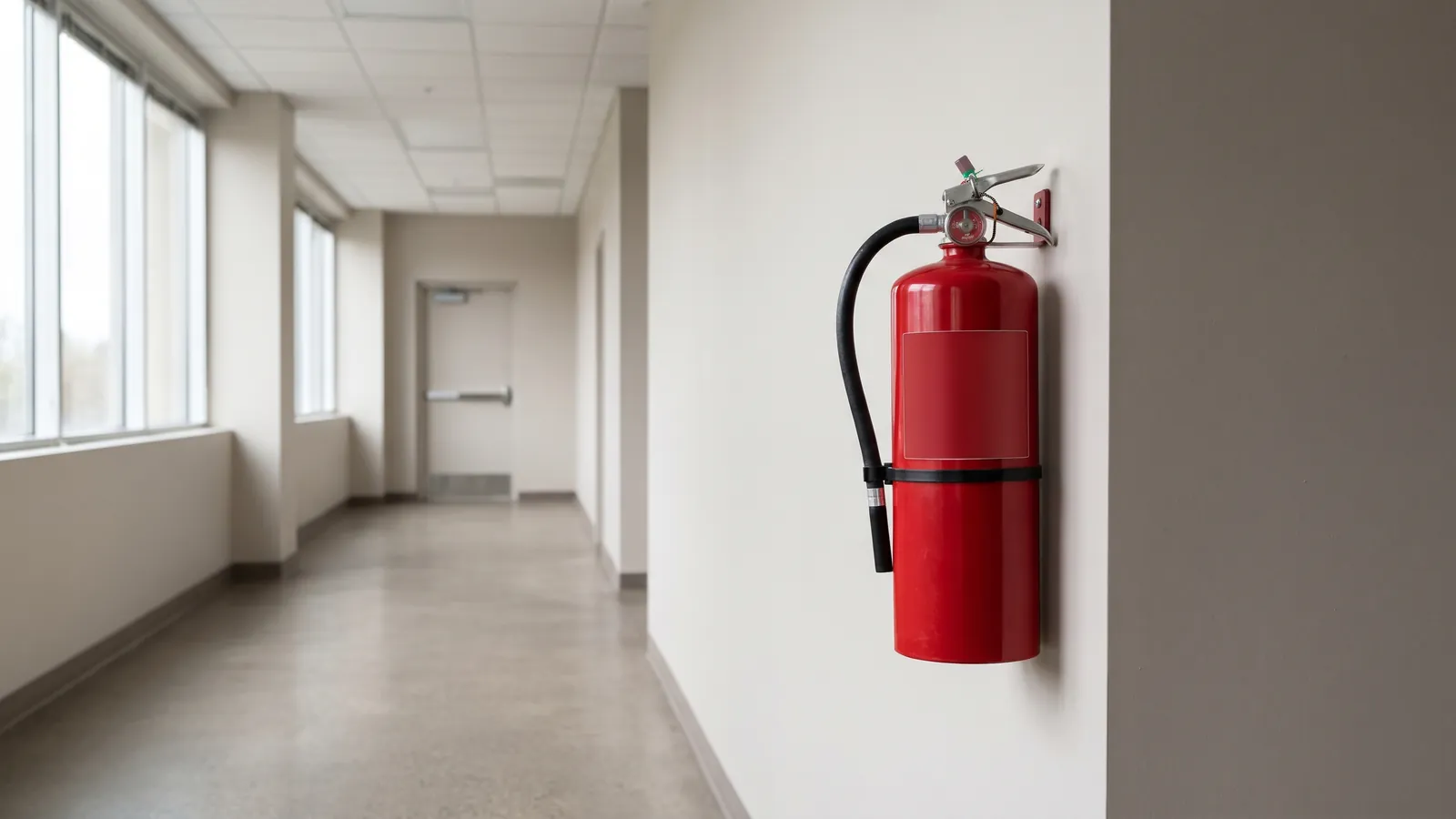
Two documents set the inspection schedule for portable fire extinguishers. The federal base is OSHA's 29 CFR 1910.157, which applies to extinguishers an employer provides for employee use. On top of that, NFPA 10, Standard for Portable Fire Extinguishers, sets the detailed procedures that state and local fire codes enforce. This page walks through both, quotes the federal rule text, and shows where a state rule (Florida is the example below) changes the details. The current NFPA 10 edition is 2026, but the edition you are held to is the one your state has adopted, which is often older.
The four recurring obligations at a glance
| Obligation | How often | OSHA rule | NFPA 10 location |
|---|---|---|---|
| Visual inspection | Monthly | 1910.157(e)(2) | Chapter 7, inspection |
| Maintenance check | Annually | 1910.157(e)(3) | Chapter 7, maintenance |
| Empty and maintain stored pressure dry chemical units that need a 12 year hydrostatic test | Every 6 years | 1910.157(e)(4) | Chapter 7, maintenance (internal examination) |
| Hydrostatic test | Every 5 or 12 years, by extinguisher type | 1910.157(f) and Table L-1 | Chapter 8, Table 8.3.1 |
In the 2010 edition of NFPA 10, cited by the Minnesota Department of Health, Chapter 7 covers inspection and maintenance and Chapter 8 covers hydrostatic testing, with internal examination intervals in Table 7.3.1.1.2 and hydrostatic test intervals in Table 8.3.1. A 2020 NFPA staff guide, which does not name an edition, points to Table 7.3.3.1 for internal examination intervals. Section numbers inside those chapters have shifted from edition to edition, so any section number on this page is tied to the edition it was cited from.
Monthly
Visual inspection of every portable extinguisher.
1910.157(e)(2)
Annually
Maintenance check, with the date recorded and the record kept.
1910.157(e)(3)
Every 6 years
Stored pressure dry chemical units that need a 12 year hydrostatic test are emptied and maintained.
1910.157(e)(4)
Every 5 or 12 years
Hydrostatic test, at the Table L-1 interval for the extinguisher type.
1910.157(f)(2)
OSHA 29 CFR 1910.157: the federal base
The OSHA rule applies to "the placement, use, maintenance, and testing of portable fire extinguishers provided for the use of employees" (1910.157(a)). Under 1910.157(e)(1) the employer is responsible for inspection, maintenance and testing. NFPA 10 likewise puts that responsibility on the owner, not the service company (2010 edition, 7.1.1, as summarized by the Minnesota Department of Health).
- Monthly: extinguishers "shall be visually inspected monthly" (e)(2).
- Annual: "The employer shall assure that portable fire extinguishers are subjected to an annual maintenance check. Stored pressure extinguishers do not require an internal examination." (e)(3).
- Annual record: the employer records the annual maintenance date and keeps it "for one year after the last entry or the life of the shell, whichever is less" (e)(3).
- 6 year: stored pressure dry chemical extinguishers that require a 12 year hydrostatic test are "emptied and subjected to applicable maintenance procedures every 6 years." Disposable, non-refillable dry chemical units are exempt, and "When recharging or hydrostatic testing is performed, the 6-year requirement begins from that date." (e)(4).
- Out of service: "alternate equivalent protection" is required while extinguishers are removed for maintenance and recharging (e)(5).
NFPA 10: monthly inspection
NFPA 10 treats inspection as a quick check, not a teardown. In the 2010 edition, cited by the Minnesota Department of Health, section 7.2.1 calls for a visual inspection when the extinguisher is first placed in service and at least monthly after that, at a minimum of 30 day intervals. The Minnesota guide lists what the check covers: the first four items below come from section 7.2.2, and the last three are other things it says to look for.
- The extinguisher is in its designated place (7.2.2).
- Nothing obstructs access or visibility (7.2.2).
- The pressure gauge reads in the proper range or position (7.2.2).
- Fullness, confirmed by weighing or lifting (7.2.2).
- Safety seals are not broken or missing.
- No evidence of physical damage, corrosion, leakage or a clogged nozzle.
- Operating instructions are legible and facing outward.
NFPA staff note that the monthly inspection does not require certification: any knowledgeable, competent person can do it, and the Minnesota guide says facility staff can perform it. The record can be a tag or label on the extinguisher, or a paper or electronic record, showing the month and year and who did the inspection, and NFPA staff say these records are kept for at least 12 months. NFPA 10 also allows electronic monitoring as an alternative to the monthly visual check.
A failed monthly inspection triggers more work. Under the 2010 edition (7.2.3), a rechargeable unit whose gauge is out of range or whose fullness cannot be confirmed goes to full maintenance, and a nonrechargeable dry chemical unit in the same state is removed from service.
NFPA 10: annual maintenance
Maintenance is the thorough examination and repair that a trained, certified technician performs. NFPA 10 requires it at least once a year, at the time of a hydrostatic test, and whenever a monthly inspection turns up a problem. It covers the mechanical parts, the extinguishing agent, the expelling means and the physical condition of the unit, following the manufacturer's service manual. The 2010 edition requires a new tamper seal whenever a rechargeable unit is maintained (7.3.2.2.1).
Each extinguisher gets a tag or label showing the month and year of the maintenance, the person who did the work and the agency that did it. When an internal examination is done, a verification of service collar goes around the neck of the cylinder with the month and year and the agency name. State rules can add to this: Florida, for example, sets the material and contents of the six year maintenance decal, covered in the next section.
NFPA 10: the 6 year maintenance
Stored pressure extinguishers that need a 12 year hydrostatic test (dry chemical units are the common example) are emptied every 6 years and given an internal examination. The interval for each extinguisher type is in a table: Table 7.3.1.1.2 in the 2010 edition, per the Minnesota Department of Health, and Table 7.3.3.1 in the 2020 NFPA staff guide, which does not name an edition. Some types are opened more often: the Minnesota Department of Health, citing the 2010 edition, lists annual internal examination for stored pressure loaded stream and antifreeze units and every 5 years for carbon dioxide and wet chemical (Class K) units. The same guide notes that nonrechargeable stored pressure units are removed from service 12 years after the date of manufacture (2010 edition, 7.3.1.2.1.3).
Florida shows how a state rule can change the clock. Florida rule 69A-21.237(2)(a) says the six year interval "shall begin from the date of manufacture of an extinguisher and, once maintenance has begun, from the date of recharging and/or internal maintenance," and that full six year procedures are performed whenever a unit covered by the rule is opened for any purpose. The six year maintenance is recorded on a durable, metallized or equivalent decal showing the year and month and the agency that did the work (69A-21.237(2)(b)).
Hydrostatic testing
OSHA requires hydrostatic testing "by trained persons with suitable testing equipment and facilities" (1910.157(f)(1)) at the intervals in Table L-1. NFPA 10 sets its intervals in Chapter 8, Table 8.3.1. Both land on 5 or 12 years for common extinguishers. A few rows from the OSHA table:
| Extinguisher type | Test interval (years) |
|---|---|
| Stored pressure water and/or antifreeze | 5 |
| Carbon dioxide | 5 |
| Aqueous Film Forming foam (AFFF) | 5 |
| Dry chemical with stainless steel | 5 |
| Dry chemical, stored pressure, with mild steel, brazed brass or aluminum shells | 12 |
| Dry chemical, cartridge or cylinder operated, with mild steel shells | 12 |
| Halon 1211 | 12 |
Table L-1 does not list wet chemical (Class K) units. The Minnesota Department of Health, citing NFPA 10, lists them at 5 years along with pressurized water, water mist and carbon dioxide.
OSHA also requires proof. Under 1910.157(f)(16) the evidence is "a certification record which includes the date of the test, the signature of the person who performed the test and the serial number, or other identifier," kept until the next retest or until the extinguisher is taken out of service. NFPA 10 adds marking: a label on low pressure cylinders with the tester's name, the test date and the test pressure, and for high pressure cylinders a stamp with the tester's identification number and date.
The scheduled test does not apply to a unit that has been repaired by soldering, welding, brazing or patching compounds, has damaged threads, has corrosion that caused pitting, has been burned in a fire, or held calcium chloride agent in a stainless steel shell (1910.157(f)(2)). A shell that fails the test, or is not fit for testing, is removed from service (f)(14).
How states adopt NFPA 10
NFPA 10 is not law on its own. States make it enforceable by adopting a named edition through their fire code or licensing rules, and that edition can lag the current one by years. Two examples:
- Florida: rule 69A-3.012 adopts "NFPA 10, 2018 edition" alongside the Florida Fire Prevention Code, 8th Edition (2023), as part of the state's uniform fire safety standards, and rule 69A-21.203 makes that edition mandatory for licensed fire equipment dealers who install, inspect, maintain or recharge portable extinguishers.
- Texas: 28 TAC 34.507 lists "NFPA 10-2018, Standard for Portable Fire Extinguishers" among the standards adopted for the state's fire extinguisher rules. The Texas Department of Insurance adopted that list in its 2023 amendments, effective September 1, 2023.
Both states also set their own tag formats, licensing and recordkeeping rules. For the details, see the Florida tag page at /florida-fire-extinguisher-tag-requirements and the Texas tag page at /texas-fire-extinguisher-tag-requirements on this site. For any other state, check which NFPA 10 edition the state fire marshal or local authority having jurisdiction enforces before relying on a section number.
Sources
- 29 CFR 1910.157, Portable fire extinguishers (eCFR)
- NFPA 10, Standard for Portable Fire Extinguishers, document information and editions (NFPA)
- Guide to Fire Extinguisher Inspection, Testing and Maintenance, NFPA Today blog, Oct 30, 2020 (archived copy)
- Maintenance and Testing of Portable Fire Extinguishers, Minnesota Department of Health (cites NFPA 10, 2010 edition)
- Fla. Admin. Code 69A-3.012, Standards of the National Fire Protection Association and Other Standards Adopted
- Fla. Admin. Code 69A-21.203, Standards of National Fire Protection Association Adopted
- Fla. Admin. Code 69A-21.237, Inspection, Maintenance and Hydrostatic Tests; Recharge, Repair, Replacement
- 28 Tex. Admin. Code 34.507, Adopted Standards (Cornell LII copy)
- Texas Department of Insurance, adoption order amending 28 TAC 34.507 (2023)