Inspection checklist
Kitchen hood suppression inspection checklist: the 6 month service under NFPA 17A and NFPA 96
Last updated
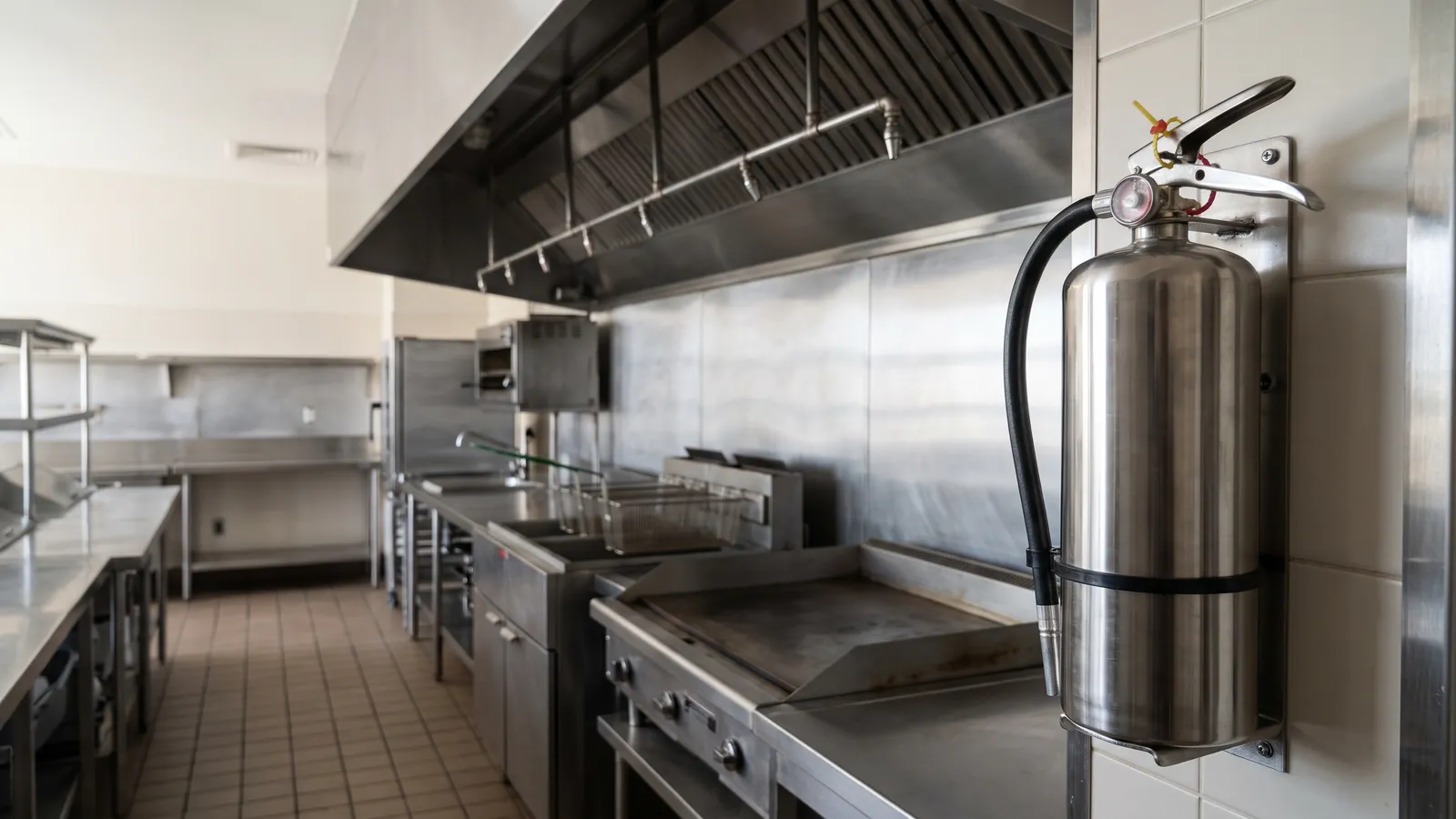
A commercial cooking fire suppression system gets a monthly look from the owner and a full service from a trained technician at least every 6 months. The service side is set by NFPA 17A (wet chemical systems), NFPA 96 (the hood, duct and cooking operation) and NFPA 10 (the K class extinguisher on the line), plus whatever your state and local authority having jurisdiction (AHJ) adopt. This page lays out the intervals in one table and the semiannual service as a checklist, with the source for each item. Section numbers change between editions, so each one below names the edition it comes from. Always check the edition your AHJ enforces and the manufacturer's listed installation and maintenance manual for the system you are servicing.
Intervals at a glance
| Item | How often | Who | Source cited |
|---|---|---|---|
| Owner inspection of the suppression system (ready condition, pull station clear, seals, tag, caps) | Monthly | Owner or trained staff | NFPA 17A (2009) 7.2.2, per Minnesota Dept. of Health guide |
| Service of the suppression system, including a test of actuation and control components and remote manual pull stations | At least every 6 months | Properly trained and qualified person | NFPA 96 (2011) 11.2.1 and 11.2.2 |
| Replace fusible links of the metal alloy type | At least semiannually | Service technician | NFPA 96 (2011) 11.2.4 |
| Examine and clean or replace fusible links other than the metal alloy type (and bulb type sprinkler heads) | At least annually | Service technician | NFPA 96 (2011) 11.2.4 |
| Hydrostatic test of wet chemical cylinders | Every 12 years | Service technician | NFPA 17A (2009) 7.5.1 |
| Inspect exhaust system for grease buildup: solid fuel cooking | Monthly | Trained and qualified company or person | NFPA 96 (2017) Table 11.4 |
| Inspect exhaust system for grease buildup: high volume (24 hour cooking, charbroiling, wok) | Quarterly | Trained and qualified company or person | NFPA 96 (2017) Table 11.4 |
| Inspect exhaust system for grease buildup: moderate volume | Semiannually | Trained and qualified company or person | NFPA 96 (2017) Table 11.4 |
| Inspect exhaust system for grease buildup: low volume (churches, day camps, seasonal businesses, senior centers) | Annually | Trained and qualified company or person | NFPA 96 (2017) Table 11.4 |
| Inspect and test listed hoods with mechanical or fire actuated dampers or internal washing parts | Every 6 months or as the manufacturer's listing says | Trained and qualified person | NFPA 96 (2017) 11.5 |
Table 11.4 sets how often the exhaust system is inspected for grease, not a fixed cleaning date. Under NFPA 96 (2017) 11.6.1, as summarized by the Village of New Paltz, the contaminated portions are cleaned when the inspection finds deposits from grease laden vapors. A busy kitchen on a quarterly inspection will usually be cleaned on that cycle, but the trigger is what the inspector finds.
Before you start
- Have the manufacturer's listed installation and maintenance manual and current service bulletins for the system. NFPA 96 (2011) 11.2.3 requires that they be followed along with the extinguishing system standard.
- Pull the last service report and the monthly owner log. A Utah fire district's NFPA 17A checklist notes that the monthly records are kept for the period between semiannual maintenance visits.
- Bring replacement fusible links of the right temperature rating, blow off caps and a cartridge or test cylinder as the manual calls for.
- Coordinate with the kitchen. The same Utah checklist lists a 17A rule that panels in fire chases or ducts are not opened while the protected appliances are in operation.
- Exhaust hoodThe canopy over the cooking line that captures grease-laden vapor.
- Exhaust ductCarries vapor out of the building; protected by its own nozzle.
- Discharge nozzlesAimed at the appliances, plenum and duct; caps should be in place.
- Fusible linksHeat detectors that trigger the system automatically.
- Agent cylinderHolds the wet chemical agent, usually in a cabinet near the line.
- Manual pull stationLets staff release the system by hand on the way out.
- Gas shutoffCuts fuel to the appliances when the system discharges.
- Cooking appliancesFryers, griddles and ranges the nozzles are placed to cover.
Semiannual service checklist
The items below follow the semiannual report form that California fire departments use (Form AES 20, which references NFPA 17A by section), the Minnesota Department of Health guide, and the operational test items on the Prosper, Texas fire marshal checklist. Work through them in the order the manual gives; this is a reminder list, not a substitute for the manual.
- Hazard check: hood, duct and protected cooking appliances have not been replaced, modified or relocated since the last service. Compare the appliance line up to the nozzle layout on the last report.
- Manual actuators (the remote pull station) are unobstructed and clearly identify the hazard they protect.
- Tamper indicators and seals are intact, and there is no obvious physical damage to the cylinder, piping or detection line.
- Gauge reads in the operable range on stored pressure units; cartridge weight is within limits on cartridge operated units; liquid level is within limits on non pressurized agent containers, with no sign of corrosion inside.
- Agent distribution piping is unobstructed and continuous.
- Nozzles are the correct type, clean and properly aimed at the appliances they cover, and every nozzle has its blow off cap in place and undamaged.
- Fusible links of the metal alloy type are replaced. Record each link's manufacture date and installation date (Form AES 20 has columns for both), and destroy the old links.
- Detection and manual actuation are tested: the system trips from the detection line and from the pull station, as the manual describes.
- Fuel shutoff operates: the gas valve shuts off on actuation and is restored manually, and electric power to the appliances under the hood trips (Prosper checklist). Form AES 20 also asks for a regulator test and a manual reset relay check where fitted.
- Interlocks function: make up air shuts off, the exhaust fan stays on or off as approved, and the system signals the fire alarm control panel where the building has one (Prosper checklist). The Minnesota guide adds a visual check of the fire alarm interconnect switches at each service.
- Agent containers, auxiliary pressure containers and hose assemblies are within their 12 year hydrostatic test dates.
- The K class extinguisher is in place, inside the travel distance, with its placard, and has a current tag.
- A new tag goes on the system showing the month and year of service and who did it, and the report is completed and signed.
Fusible link interval: the Minnesota guide cites NFPA 96 (2011) 11.2.4 for replacing metal alloy links at least semiannually. In 2021 the NFPA 17 committee added the same semiannual replacement language to the dry chemical standard, with a statement that it aligns with similar requirements in NFPA 17A. Some checklists still in circulation say annually: a 2001 New Jersey bulletin gives the annual interval under the 1994 editions of NFPA 17 and 17A. Go by the edition your AHJ enforces and the system manual.
Manual pull station and gas shutoff
Every wet chemical system has both automatic and manual actuation. The manual pull station sits in a path of egress so a cook can trip the system while leaving the line; the Utah checklist lists a mounting height of 42 to 48 inches above the floor, and a Prosper, Texas fire marshal checklist cites NFPA 96 for placing it 10 to 20 feet from the hood in the path of egress. Local rules on placement vary, so check what your AHJ inspects for.
On actuation, all sources of fuel and electric power that produce heat to the protected appliances shut down, and gas appliances under the same hood that are not protected are shut off too (Utah checklist, NFPA 17A). The Prosper checklist's operational test asks whether the gas valve shut off and was restored manually, and Form AES 20 has the fuel shutoff test on the semiannual report, so prove both at every service.
The K class extinguisher on the cooking line
NFPA 10 6.6.1 requires a K class extinguisher where there is a potential for fires in combustible cooking media (vegetable or animal oils and fats), and 6.6.2 sets the maximum travel distance at 30 ft from the hazard. Where an automatic system protects the hazard, 5.5.4.5.3 requires a placard near the extinguisher stating that the fire protection system is to be actuated before the extinguisher is used (as quoted by Amerex). The 2012 International Fire Code (904.11.5.2, cited on the Prosper checklist) adds a second K class unit for deep fat fryers over 80 pounds, where that code is adopted.
The Prosper checklist also asks whether the K class unit carries a current state certification tag (citing NFPA 96 10.9.5), and the Minnesota monthly log has a line for keeping portable extinguishers unobstructed, since carts parked in front of them are a common finding.
Paperwork in Florida and Texas
Florida rule 69A-21.304 requires an inspection report whenever a pre-engineered system is installed, inspected, repaired, maintained or otherwise serviced. The report states whether it is an "annual inspection; semi-annual inspection; a recharge; a new installation; or a renovation," records whether fuel shutoff is gas or electric and its size, and for new installations, first inspections or changes includes a drawing with the "positions of all nozzles, identification of nozzles, their distances from the hazards that they protect." One signed copy goes to the owner, and the dealer keeps its copy for not less than three years after the last inspection.
In Texas, the State Fire Marshal licenses individuals by type: a Type K (FEL-K) licensee "is permitted to install, certify, or service any pre-engineered fixed fire extinguisher systems used to protect a cooking area, and portable extinguishers," and a Type A (FEL-A) licensee covers all pre-engineered fixed systems. Under 28 TAC 34.520, after any service the licensee completes a service tag in detail, showing all work done, signs it, and attaches it to the portable or fixed system where it does not hamper actuation, and a new tag goes on each time service is performed.
Sources
- Minnesota Department of Health, Protection of Kitchen Cooking Equipment (rev. June 2024; cites NFPA 96 2011 and NFPA 17A 2009)
- Village of New Paltz, Kitchen Hood Cleaning Requirements (summary of NFPA 96 2017 Table 11.4, 11.5 and 11.6)
- Uintah Fire Suppression S.S.D. (Utah), Wet Chemical Extinguishing Systems (NFPA 17A) checklist
- City of Oxnard, Form AES 20 Semi-Annual Report, Wet Chemical Pre-Engineered Fire Extinguishing System
- NFPA 17 First Revision statements (2021), FR-14 on fusible link replacement
- New Jersey Division of Fire Safety, Bulletin 2001-2, commercial range hood suppression systems (cites the 1994 editions of NFPA 17 and 17A)
- Prosper (Texas) Fire Marshal's Office, Kitchen Hood Suppression System checklist
- Amerex, What is a Class K fire? (quotes NFPA 10 6.6.1, 6.6.2 and 5.5.4.5.3)
- Fla. Admin. Code R. 69A-21.304, Installation; Service (Cornell LII text)
- Florida Administrative Code, Rule 69A-21.304 (flrules.org)
- 28 Tex. Admin. Code 34.520, Service Tags (Cornell LII text)
- Texas Department of Insurance, Fire extinguisher registration, license and test information