Equipment guide
Class K fire extinguisher: what it is, where it is required and how to service it
Last updated
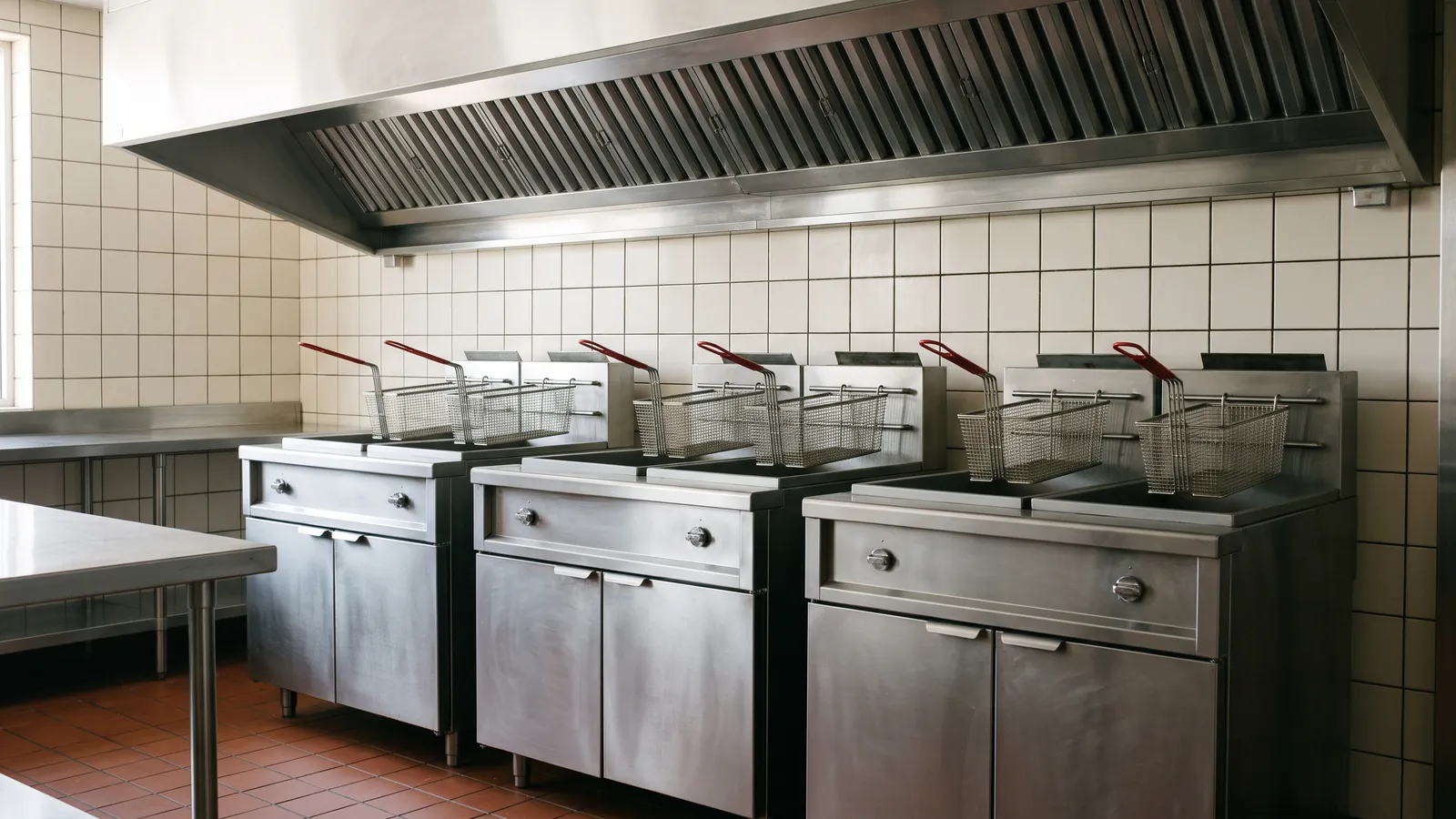
A Class K fire extinguisher is the portable unit for fires in cooking oils and fats, the kind that start in a fryer. It holds a wet chemical agent instead of dry powder, codes require it where cooking oils and fats are used, and it is meant to be used after the kitchen hood suppression system has discharged, not instead of it. This page explains what the K rating means, what the codes require (with the edition or code each rule comes from), how the unit fits with the hood system, and how its service cycle differs from the dry chemical units that make up most of a route. Section numbers move between NFPA 10 editions, so each one below names its source, and the edition that applies to you is the one your state or local authority having jurisdiction (AHJ) has adopted.
What Class K means
Class K is the fire class for cooking appliances that use combustible cooking media, meaning vegetable or animal oils and fats. Amerex, a major extinguisher manufacturer, says the class was introduced in the early 1990s. The trigger was fire testing on a commercially available deep fat fryer: Amerex explains that UL 300, the fire test standard for commercial cooking suppression systems, launched in November 1994 using such a fryer, and that lessons from it were carried into UL 711, the rating test for portable extinguishers. None of the 40-B:C dry chemical extinguishers in use at the time could pass the full test, which Amerex says drove the creation of the K rating.
Grinnell Mutual's loss control bulletin notes that vegetable oils burn hotter than animal fats, which makes the fires harder to put out, and that a 1998 revision of NFPA 10 required extinguishers for cooking appliances using combustible cooking media to be listed and labeled for Class K fires.
How wet chemical agent works: saponification
The agent reacts with the burning fat in a process called saponification, which Amerex likens to making soap. The result is a foam blanket on the surface of the oil that cuts off oxygen. Amerex says wet chemical makes a much stronger and thicker blanket than dry chemical and also cools the oil, which dry chemical does not. Grinnell Mutual warns that dry chemical alone carries a high risk of re-flash in a vegetable oil fire.
- Lower splash hazard when the agent hits the oil (Grinnell Mutual).
- A foam layer that smothers the fire (Amerex, Grinnell Mutual).
- Cooling of the appliance and the oil, which reduces the chance of re-flash (Grinnell Mutual).
- Better visibility and easier cleanup (Grinnell Mutual).
Where a Class K extinguisher is required
NFPA 10 requires Class K extinguishers where there is a potential for fires in combustible cooking media (section 6.6.1), and section 6.6.2 reads "Maximum travel distance shall not exceed 30 ft (9.1 m) from the hazard to the extinguishers." Both are quoted by Amerex, which does not name the edition, so confirm the section numbers against the edition your AHJ enforces. Grinnell Mutual gives the same 30 foot limit measured from the cooking appliances. Our kitchen hood suppression inspection checklist page covers how these items fit into the semiannual hood service.
The fire code adds detail on top of NFPA 10. The 2020 Fire Code of New York State, an International Fire Code based code, is a useful example because its text is public. Other IFC based state and local codes may number these sections differently.
| Situation | What the code requires | Section |
|---|---|---|
| Any extinguisher provided for cooking equipment | An approved type compatible with the automatic fire-extinguishing system agent | 906.4 |
| Cooking with solid fuels or vegetable or animal oils and fats | A Class K rated portable extinguisher | 906.4 |
| Solid fuel cooking appliances with fireboxes of 5 cubic feet or less, under a hood or not | At least one 2.5 gallon (9 L) or two 1.5 gallon (6 L) Class K wet chemical extinguishers | 906.4.1 |
| Up to four deep fat fryers of 80 pounds maximum cooking medium each | One listed Class K extinguisher of at least 1.5 gallon (6 L) | 906.4.2, item 1 |
| Each additional group of four such fryers | One more Class K extinguisher of at least 1.5 gallon (6 L) | 906.4.2, item 2 |
| A single fryer over 6 square feet of surface area | Class K extinguishers installed per the extinguisher manufacturer's recommendations | 906.4.2, item 3 |
Amerex separately quotes NFPA 10 section 6.7 for solid fuel appliances with fireboxes of 5 cubic feet or less as calling for at least a listed 2-A rated water type extinguisher or a 1.6 gallon (6 L) wet chemical extinguisher listed for Class K fires. That differs from the New York figure above, which is why the governing document matters: check which code and edition your AHJ applies to wood fired ovens and charbroilers before you size the unit.
The same New York code sets mounting rules that apply to the K unit like any other: the top no more than 5 feet above the floor for extinguishers of 40 pounds or less (906.9.1), at least 4 inches of floor clearance (906.9.3), along normal paths of travel (906.5), and not obstructed or obscured from view (906.6).
The extinguisher is the backup to the hood system
A Class K extinguisher does not replace the fixed wet chemical system over the cooking line. Amerex quotes NFPA 96 section 10.2.1 as treating automatic fire-extinguishing systems as primary protection and portable extinguishers as secondary backup. Grinnell Mutual puts the order plainly: the extinguisher is used after the fixed system has operated and the energy to the cooking appliance is off, and if the system has not operated, staff activate it manually first.
That order is printed on the wall. Where a hazard is protected by an automatic system, NFPA 10 section 5.5.4.5.3 (quoted by Amerex, edition not named) requires a placard near the extinguisher stating "that the fire protection system shall be actuated prior to using the fire extinguisher." Amerex also cites NFPA 96 section 12.1.4 for training staff on manual actuation of the system, for new hires and annually for all employees, which is a natural thing to mention to a kitchen manager while you are on site.
Compatibility is a code requirement, not just good practice. The 2020 Fire Code of New York State (906.4) requires an extinguisher protecting cooking equipment to be of an approved type compatible with the automatic system agent. Grinnell Mutual, an insurer, goes further and recommends removing dry chemical extinguishers from the cooking area altogether.
Service cycle: why wet chemical units are on a 5 year clock
Monthly inspection and annual maintenance work the same way for a K unit as for any other extinguisher (see our fire extinguisher inspection requirements page). The difference is the longer cycle. A typical stored pressure dry chemical unit is emptied for internal examination every 6 years and hydrostatically tested every 12. A wet chemical unit gets both every 5 years, so the two line up on the same visit.
Every 30 days
Visual inspection, as for every portable extinguisher.
NFPA 10 (2007) 6.2.1
Every year
Maintenance by a trained technician.
NFPA 10 (2007) 6.3.1
Every 5 years
Internal examination of the emptied extinguisher.
NFPA 10 (2010) Table 7.3.1.1.2
Every 5 years
Hydrostatic test, the same interval as carbon dioxide and pressurized water units.
NFPA 10 (2010) Table 8.3.1
The references move between editions. A University of Colorado table built from the 2007 edition lists wet chemical at 5 years in its recharging column under section 6.4.3.11 and the 5 year hydrostatic test under Table 7.2. The Minnesota Department of Health, citing the 2010 edition, puts the internal examination in Table 7.3.1.1.2 and the hydrostatic test in Table 8.3.1. Wet chemical cylinders are low pressure cylinders, so a passed hydrostatic test is recorded on a durable label showing the month and year, the test pressure and who did the work (2010 edition, 8.7.2, per the Minnesota guide). High pressure cylinders such as carbon dioxide are stamped instead (8.7.3).
California writes the alignment into its own regulations. Title 19, section 575.16 requires internal maintenance of wet chemical and water mist extinguishers every 5 years, at the time of the hydrostatic test, following the manufacturer's recommendations. Section 578.12 is short enough to quote in full: "Wet chemical agents shall not be re-used. If a wet chemical extinguisher is partially discharged, all remaining wet chemical shall be discarded."
Electronic monitoring is another place K units differ. The 2020 Fire Code of New York State (906.2, exception 2) lets extinguishers supervised by a listed electronic monitoring device skip the 30 day inspection and stretch maintenance to every 3 years, when the code's listed conditions are met, but only for dry chemical or halogenated agent units. A wet chemical unit on the same wall stays on the normal schedule under that code.
Common mistakes in restaurant kitchens
- An ABC dry chemical unit hanging by the fryer as the only kitchen extinguisher. It is not a Class K extinguisher and, under codes like New York's, it must also be compatible with the hood system agent.
- The K unit mounted more than 30 feet of travel from the cooking hazard, for example after the line is rearranged.
- No placard, or a placard that has fallen off, so staff reach for the extinguisher before pulling the hood system.
- Carts or stacked supplies blocking the extinguisher. The Minnesota Department of Health says it is not uncommon to find kitchen extinguishers blocked by carts during its surveys and suggests adding the item to the monthly inspection checklist.
- Added fryers without added extinguishers. New York's 906.4.2 calls for one more K unit for every additional group of four fryers beyond the first four.
- A partly discharged unit topped off instead of emptied and recharged. California prohibits re-using wet chemical agent.
- The 5 year internal examination and hydrostatic test missed because the unit was tracked on the same 6 and 12 year clock as the dry chemical units in the building.
Related guides
- Kitchen hood suppression inspection checklist: the 6 month service under NFPA 17A and NFPA 96
A semiannual kitchen hood suppression inspection checklist: NFPA 17A wet chemical items, NFPA 96 grease inspection intervals, fusible links, K class unit.
- Fire extinguisher hydrostatic test: intervals by type, DOT cylinder rules and test labels
Fire extinguisher hydrostatic test intervals by type under OSHA Table L-1 and NFPA 10, DOT cylinder rules in 49 CFR 180, test labels, stamps and condemnation.
- Fire extinguisher inspection requirements: OSHA 1910.157 and NFPA 10
Monthly inspection, annual maintenance, 6 year maintenance and hydrostatic testing under OSHA 1910.157 and NFPA 10, with the rule text and state adoption.
- Fire Extinguisher Expiration Date Checker
Check when a fire extinguisher's next hydrostatic test, 6-year maintenance or end of service life is due, by type and manufacture date, with the NFPA 10 rule.
Sources
- Amerex, What is a Class K fire? (quotes NFPA 10 6.6.1, 6.6.2, 6.7 and 5.5.4.5.3, and NFPA 96 10.2.1 and 12.1.4)
- Grinnell Mutual, Loss Control Bulletin: Class K fire extinguishers
- 2020 Fire Code of New York State, Section 906 excerpt (New York State Fair copy)
- Minnesota Department of Health, Maintenance and Testing of Portable Fire Extinguishers (cites NFPA 10, 2010 edition)
- Minnesota Department of Health, Protection of Kitchen Cooking Equipment (rev. June 2024)
- University of Colorado Boulder, Inspection, Maintenance, Testing and Recharging Periods for Portable Fire Extinguishers (NFPA 10, 2007 edition)
- Cal. Code Regs. tit. 19, 575.16, Wet Chemical and Water Mist Fire Extinguishers (Cornell LII)
- Cal. Code Regs. tit. 19, 578.12, Wet Chemical Agent Re-Use (Cornell LII)