Requirements guide
Emergency lighting inspection: NFPA 101 testing, OSHA exit route rules and a tech checklist
Last updated
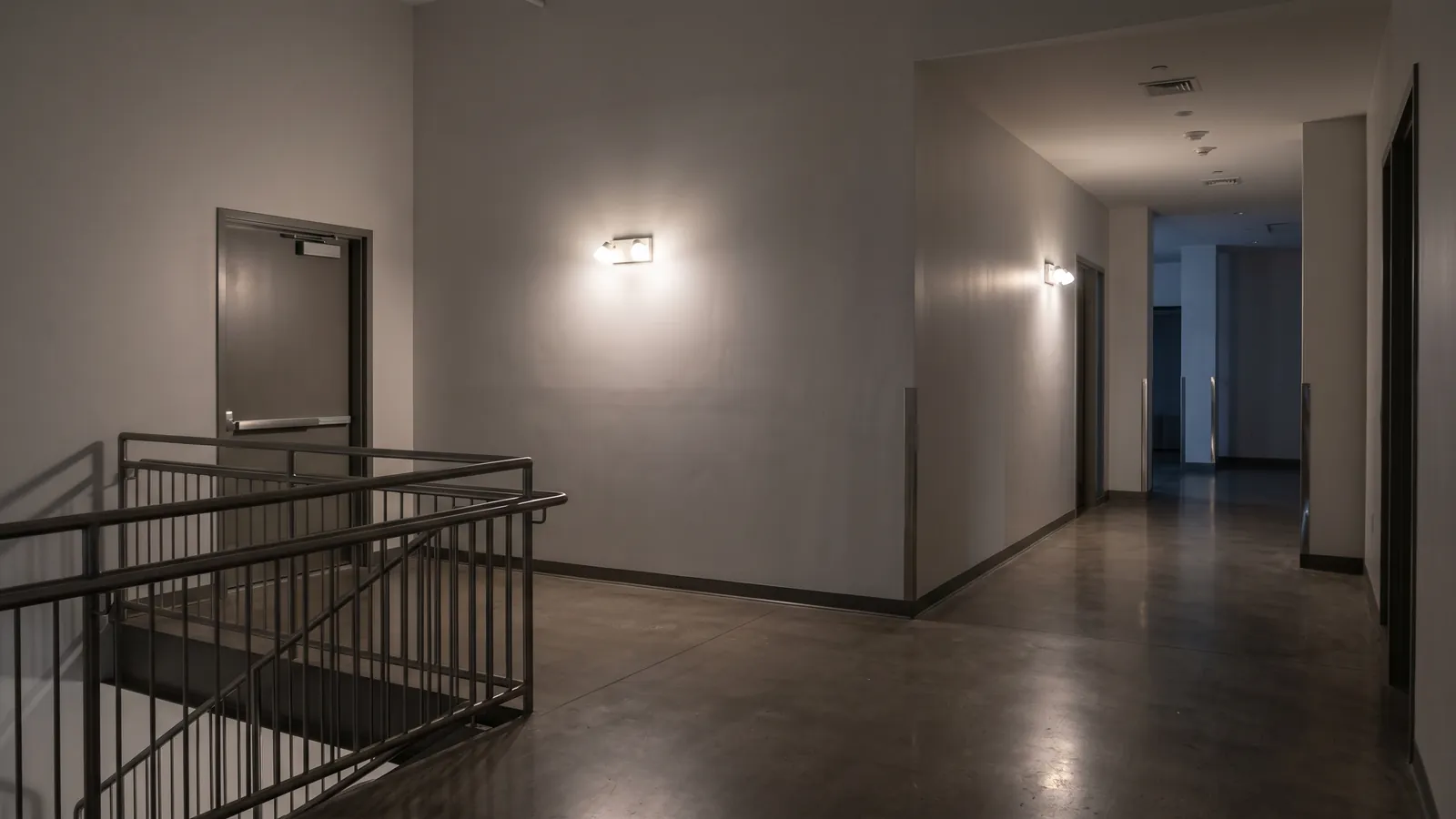
Battery emergency lights and lighted exit signs are a natural add-on for an extinguisher route: they sit in the same corridors, and the codes that require them call for a short test every month and a longer test every year. The testing schedule comes from NFPA 101, Life Safety Code, and from the fire code your state or city adopts. OSHA's exit route rule in 29 CFR 1910.37 sets the outcome (lit exit routes and readable, lit exit signs) but no test interval. This page covers battery unit equipment and battery exit signs, not generator-fed systems. Section numbers below are tied to the edition they were cited from, because they move between editions. Always check the edition your authority having jurisdiction (AHJ) enforces.
Test intervals at a glance
| Equipment type | Every 30 days (3 to 5 weeks apart) | Annually | NFPA 101 (2012) section |
|---|---|---|---|
| Standard battery unit or exit sign | Manual functional test, at least 30 seconds | Manual functional test, at least 90 minutes | 7.9.3.1.1 |
| Self-testing, self-diagnostic unit | Unit tests itself for at least 30 seconds and runs a diagnostic; a person visually inspects it | Manual functional test, at least 90 minutes | 7.9.3.1.2 |
| Computer-based self-testing system | System tests itself for at least 30 seconds and runs a diagnostic | System runs the 90 minute test automatically | 7.9.3.1.3 |
Every 30 days
Functional test of at least 30 seconds, with 3 to 5 weeks allowed between tests. The equipment must stay fully operational for the whole test.
NFPA 101 (2012) 7.9.3.1.1
Annually
Functional test of at least 90 minutes on battery-powered equipment, fully operational for the whole test.
NFPA 101 (2012) 7.9.3.1.1
The Minnesota Department of Health explains the 3 to 5 week window as the code's way of allowing for weekends and holidays, and notes that the interval can be extended beyond 30 days only with technical justification and the AHJ's approval. The same testing applies to exit signs that have a battery emergency source (2012 edition, 7.10.9.2). The older 2000 edition, section 7.9.3, already set the same 30 second monthly and 1.5 hour annual tests, per a South Dakota Department of Health test log.
What OSHA 1910.37 requires (and what it does not)
OSHA's exit route rule covers lighting and marking, not a test schedule. The text of 1910.37 sets no monthly or annual test. What it does require:
- Lighting: "Each exit route must be adequately lighted so that an employee with normal vision can see along the exit route" (1910.37(b)(1)).
- Exit signs: each exit must be "clearly visible and marked by a sign reading" Exit (b)(2), and exit route doors are kept free of decorations or signs that hide them (b)(3).
- Direction signs: where the way to the exit is not obvious, signs along the exit access show the direction, and "the line-of-sight to an exit sign must clearly be visible at all times" (b)(4).
- Not an Exit: a door or passage that could be mistaken for an exit is marked "Not an Exit" or labeled with its actual use, such as closet (b)(5).
- Sign illumination: each exit sign is lit "to a surface value of at least five foot-candles (54 lux) by a reliable light source" and is distinctive in color; self-luminous or electroluminescent signs need at least .06 footlamberts (b)(6).
- Letter size: the word Exit is at least 6 inches high, with principal strokes at least three-fourths of an inch wide (b)(7).
Under 1910.35, OSHA deems an employer compliant with the corresponding requirements of 1910.34, 1910.36 and 1910.37 if it complies with the exit route provisions of NFPA 101 (2009 edition) or the International Fire Code (2009 edition). In practice the emergency lighting test schedule your customers are held to comes from NFPA 101 or their local fire code, and the OSHA rule is the floor for what the employee must be able to see.
A sign that is dark or below 5 foot-candles is an OSHA problem regardless of the test log. In a 1991 letter on self-luminous and electroluminescent signs (now archived, and citing the pre-2002 paragraph number 1910.37(q)(6)), OSHA wrote that if the illumination on the surface of exit signs is not maintained at or above 5 footcandles, the employer is in violation.
Self-testing and self-diagnostic units
Self-testing units cut down the monthly work, but they do not remove it. Under the 2012 edition as summarized by the Minnesota Department of Health, a self-testing, self-diagnostic unit must test itself for at least 30 seconds and run a diagnostic routine at least once every 30 days, and it must be able to show a failure on a status indicator. Someone still has to look at it every month, and the 90 minute annual test is still a manual job. Only a computer-based self-testing system runs the annual 90 minute test on its own, and it must be able to provide a history of tests and failures at all times (7.9.3.1.3(5)).
For a service company this changes the visit, not the frequency. On self-testing units the monthly stop becomes a walk to read every status indicator and log what it shows, and the annual visit still includes a timed discharge.
Emergency light inspection checklist for each visit
- Check the unit inventory against the building: every emergency light and battery exit sign has a location, ideally marked on a floor plan, so none is skipped.
- Look at each unit: mounted, undamaged, lamps or heads aimed at the egress path, charging or status indicator showing normal.
- Check exit signs against the OSHA marking rules: lit, readable from the path of travel, not blocked by decorations or stock, and Not an Exit doors marked.
- Run the test by a method that actually puts the unit on battery. The Minnesota Department of Health warns that on older units the test button can fail to interrupt AC power, so it tests only the lamps, not the battery.
- For a cord-and-plug unit (the electrical code allows cords up to 3 feet), unplug it for the test, then plug it back in right away to avoid a deep discharge that shortens battery life.
- Shutting off the breaker that feeds the units is the most complete test of lamps and batteries, but it drops everything else on that circuit, so plan it with the owner.
- Time the test: at least 30 seconds monthly and at least 90 minutes annually. The unit must stay fully operational the whole time. Some dimming of the lamps may occur, but the code's minimum light levels must hold for the full 90 minutes.
- Do not add a local test switch to make the 90 minute test easier. The Minnesota Department of Health says that would violate the electrical code, because unit equipment must be on the same branch circuit as the normal lighting, ahead of any local switch. Ask the manufacturer how to hold the test.
- Note battery age. The Minnesota Department of Health gives rough service lives of 5 to 10 years for maintenance-free lead acid and 10 to 15 years for nickel cadmium, and says the manufacturer is the best source.
- Record every unit as pass or fail, and write down what was done about each failure.
The record a service company keeps for the building owner
NFPA 101 requires written records. In the 2012 edition, sections 7.9.3.1.1(5) and 7.9.3.1.2(7) require written records of the testing to be kept for inspection by the AHJ, according to the Minnesota Department of Health. The South Dakota log built on the 2000 edition asks for the test date, the person conducting the test, a yes or no on whether the system was tested for the full duration and operated properly, and remarks on failures and corrective action.
Local fire codes can be stricter or different. As one example, the Minnesota Department of Health reports that the 2020 Minnesota State Fire Code (section 1031.10 and 1031.10.1) requires test records to stay on the premises for at least 3 years and to include, at a minimum, the location of the unit tested, pass or fail, the date and the name of the person who tested it. That same code, in section 604.5, asks for an annual test of at least 30 minutes rather than 90, which is why the edition and code your AHJ enforces matters.
- Unit location (room, corridor or floor plan reference) and unit type.
- Test date and test type (30 second monthly or 90 minute annual).
- Name of the person who tested it.
- Pass or fail, with the problem and the corrective action.
- Date of installation and date of battery replacement. The Minnesota Department of Health recommends logging both, and notes that the installation date is the baseline for confirming tests are on schedule.
The building owner holds the record, but the owner usually relies on the service company to produce it at an inspection. The same customer often has extinguishers and a kitchen hood system on their own clocks: see our fire extinguisher inspection requirements page and our kitchen hood suppression inspection checklist page for those schedules, and our fire protection service software buyer guide for running all three at one site.
Related guides
- Fire extinguisher inspection checklist: monthly checks and annual maintenance
A monthly and annual fire extinguisher inspection checklist built from OSHA 1910.157 and NFPA 10: what to check, what fails, and what to record.
- Fire extinguisher inspection requirements: OSHA 1910.157 and NFPA 10
Monthly inspection, annual maintenance, 6 year maintenance and hydrostatic testing under OSHA 1910.157 and NFPA 10, with the rule text and state adoption.
- Kitchen hood suppression inspection checklist: the 6 month service under NFPA 17A and NFPA 96
A semiannual kitchen hood suppression inspection checklist: NFPA 17A wet chemical items, NFPA 96 grease inspection intervals, fusible links, K class unit.
- Fire protection service software: what a small extinguisher shop actually needs
What a 1 to 10 tech fire extinguisher service company needs from inspection software: tag records, reports, invoices, QuickBooks sync, offline use and pricing.
Sources
- 29 CFR 1910.37, Maintenance, safeguards, and operational features for exit routes (OSHA)
- 29 CFR 1910.35, Compliance with alternate exit-route codes (OSHA)
- OSHA interpretation letter, Use of self-luminous and electroluminescent exit signs, February 1, 1991 (archived)
- Maintenance of Battery-Operated Emergency Lights, Minnesota Department of Health (cites NFPA 101, 2012 edition), rev June 2024
- Emergency Lighting Test Log, South Dakota Department of Health (cites NFPA 101, 2000 edition, 7.9.3)