California rules guide
California fire extinguisher license, certificate and tag requirements
Last updated
California regulates portable extinguisher service with its own rulebook: Health and Safety Code sections 13160 to 13190.4, and the California Code of Regulations, Title 19, Division 1, Chapter 3 (Fire Extinguishers), enforced by the CAL FIRE Office of the State Fire Marshal (OSFM). This page covers the license and certificate types as the rules name them, exams and renewal, and what the tag, collar and hydrostatic test label must show, quoted from the OSFM compilation (January 2022 edition).
Two credentials: the concern license and the certificate of registration
California licenses the company and the person separately. H&S 13163: "No person shall engage in the business of, nor perform for a fee, the servicing, charging, or testing of portable fire extinguishers without a license issued by the State Fire Marshal." H&S 13175: "No natural person shall service, charge, or test any portable fire extinguisher without a certificate of registration issued by the State Fire Marshal."
The company license is the concern license, and its number is the "E" number. The technician's certificate of registration number is the "EE" number. A certificate holder cannot work for a fee alone: they need their own license or must be employed by a licensed concern (19 CCR 595.9(c) and (d)).
New hires get a short window. Under H&S 13175.1, new employees of a licensed concern may service extinguishers for up to 90 days without a certificate, but only "in the presence of and under the direct supervision of" a certificate holder.
Concern license types (19 CCR 595.5)
| Type | What it authorizes |
|---|---|
| A | Any or all types of extinguishers, including everything in Types B through F |
| B | Maintain and recharge water based units; external maintenance of carbon dioxide |
| C | Hydrostatic tests of low pressure cylinders (DOT requalification facility if DOT cylinders are tested) |
| D | Maintain and recharge dry chemical and dry powder; external maintenance of halogenated agent units |
| E | Hydrostatic tests of high pressure cylinders; internal maintenance and recharge of carbon dioxide (DOT requalification facility) |
| F | Internal maintenance, recharge and recovery of halogenated agents (listed Halon 1211 closed recovery system) |
| L (Limited) | Entities maintaining only their own extinguishers; external annual maintenance only |
- Experience, 595.5(f): at least 24 months documented in servicing, maintenance, recharging, repairing, hydrostatic testing and installation, through employer letters.
- Work outside your types, 595.5(c) and (d): take the order, but consign it to a classified concern, with reciprocal letters of agreement on file with the State Fire Marshal.
- Insurance, 595.13: liability coverage of not less than $1,000,000 combined single limit per occurrence.
- Location, 595.7: no P.O. box or mail drop; a local business license must match the physical address, and each place of business needs its own license (H&S 13164).
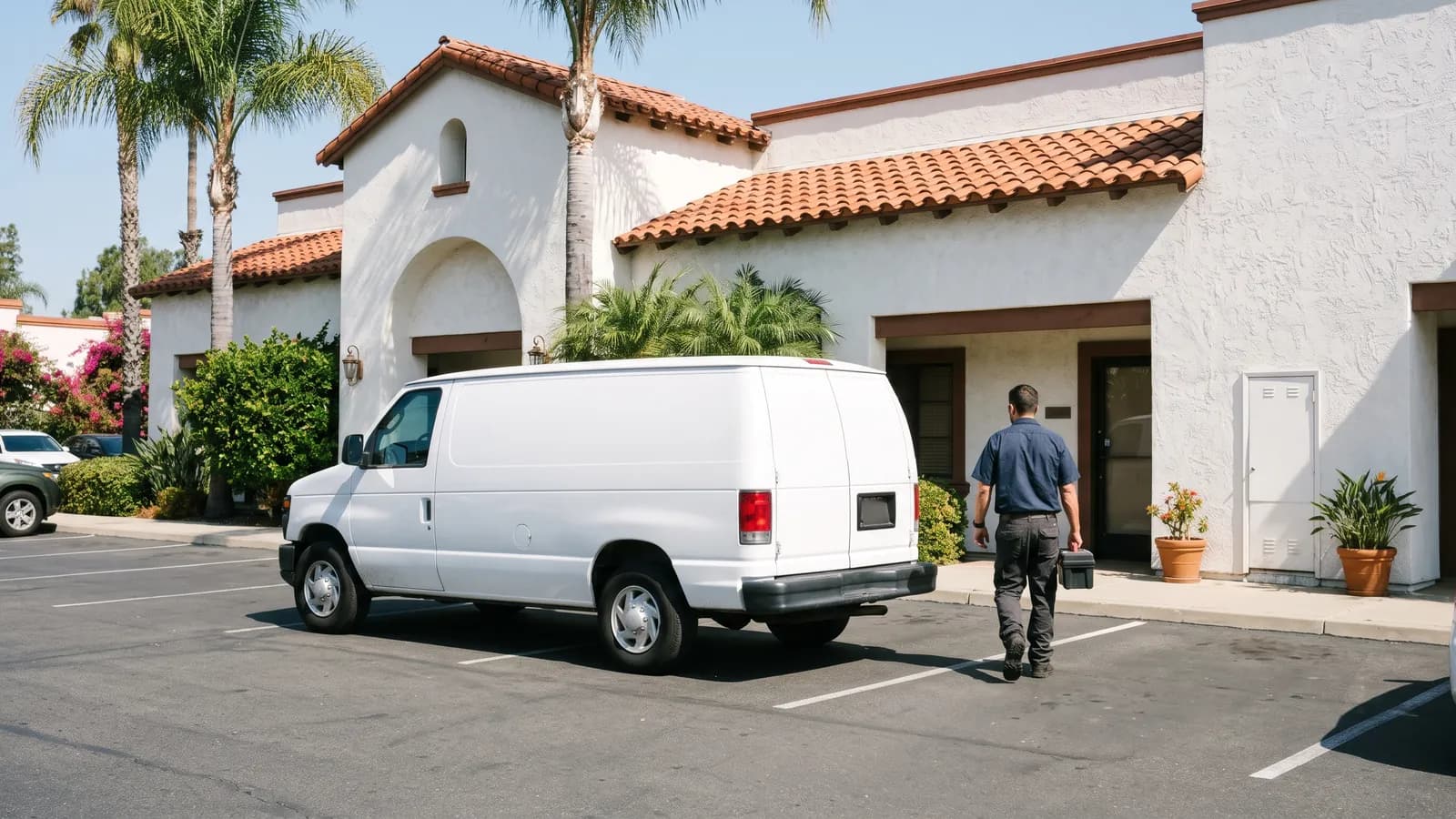
- Vehicles, 560.4: business name, license number and phone on each side of each service vehicle, at least 1 1/2 inches high.
Certificate of registration types and employer duties
| Type | Acts covered |
|---|---|
| Type 1 | Recharge and maintenance of any or all types of extinguishers |
| Type 2 | Hydrostatic test of low pressure non-DOT cylinders |
| Type 3 | Hydrostatic test of DOT specification cylinders |
Technicians carry the certificate card while working (595.11) and must be at least 18 (595.3). Under 595.12, the licensed concern reports to the State Fire Marshal in writing, annually and within seven days of any hire or termination, the name, address, and certificate number and type of everyone doing maintenance, recharging or hydrostatic testing for it.
Exams and the renewal calendar
H&S 13177 requires every certificate applicant to "take and pass a written examination which may be supplemented by practical tests." The OSFM candidate handbook (October 2024) says exams are computer based, multiple choice and booked through Pearson VUE at least 24 hours ahead, with no reference materials allowed in the room. It lists Fire Extinguisher 1, 2 and 3 plus combined versions, with a 15 day wait before a retake, matching 19 CCR 595.10(b).
By November 1
Renewal application and fee due for licenses and certificates.
H&S 13167, 13180
After November 1
A 50 percent penalty fee is added to a late renewal.
H&S 13189(b)
December 31
Licenses and certificates expire; renewals run January 1 to December 31.
H&S 13166, 13179
Expired over 1 year
The renewal is treated as an original application.
19 CCR 595.2
Every 4 years
A written exam at renewal, when deemed necessary by the State Fire Marshal.
19 CCR 595.10(c)
Fees are set under H&S 13189 and listed in 19 CCR 560; check the current schedule with OSFM before applying.
What the annual maintenance tag must show
Under 19 CCR 596.1(a), the annual maintenance tag carries these items, machine printed, on one side:
- "Do Not Remove by Order of the State Fire Marshal" at the top
- Concern name as listed on the license
- Concern business location
- License number ("E" number) and license type
- Service maintenance / new extinguisher block
- Date service performed
- A printed "EE" followed by space for the individual's number
- The State Fire Marshal Seal of Registration
- Signature line for the person performing or supervising the service
- A valid local telephone number for the concern
| Rule | What it says | Section |
|---|---|---|
| Approval | A printer's proof of both sides of each tag, collar or label goes to the State Fire Marshal with each original and renewal license application and whenever the design changes | 596(a) |
| Size | 4 3/4 by 2 3/8 inches, with 1/2 inch deviation permitted each way | 596.2(a) |
| Color | "shall not be red in color" | 596.2(d) |
| Year blocks | No more than five | 596.4(a) |
| Attaching | Wire, string, plastic ties or an approved self-adhesive tag, not on the front of the extinguisher | 596.3(a) |
Section 596.5 requires the date, a legible EE number and the signature of the person performing or supervising the service to be written on the tag or collar on the day of service: "A rubber stamp of name or initials is not acceptable."
Collars, hydrostatic test labels and red tags
- Verification of Service collar, 596(c) and 596.1(c): required after maintenance that included an internal examination or a recharge, except cartridge or cylinder operated and carbon dioxide units. It shows the E number, month and year, EE number, signature space and concern name, and is fitted while the valve is off so the valve traps it (596.3(b)).
- Hydrostatic test label, 596.1(d): concern name and address, E number, DOT RIN if applicable, month and year, test pressure in PSI, and "S" if the modified test method was used.
- Condemned units, 577.1(b): an extinguisher repaired, converted or altered against the rules gets a red tag reading "Condemned" on each face.
For shops that also service kitchen hood systems: the tag bearing the State Fire Marshal seal "shall not be attached in any manner to any device or system which is not a portable fire extinguisher" (596.6(c)). No tag may be attached unless the service "has actually been performed or supervised by the person affixing such tag" (596.6(b)).
Paperwork rules specific to California
- Itemized invoice, 575.1(f): for any service, hydrostatic test or parts replacement.
- Returned parts, 575.1(g): a written offer to return replaced parts, in capital letters of at least 10 point bold type.
- Early service, 575.1(h): not more than 30 days before the due date unless the owner approves and initials it in writing.
- New extinguishers, 575.1(d): due for maintenance within one year of manufacture; units more than two years old cannot be tagged as new.
Title 19 also sets its own inspection, maintenance and hydrostatic intervals. For the OSHA and NFPA 10 intervals, see our fire extinguisher inspection requirements page.
California and NFPA 10
California does not adopt a named NFPA 10 edition for extinguisher service; it writes its own standard. H&S 13160 says only that the State Fire Marshal "shall consider the standards of the National Fire Protection Association" when adopting rules, and the OSFM compilation of Title 19, Chapter 3 does not adopt an NFPA 10 edition.
In the model International Fire Code, section 906.2 has extinguishers maintained in accordance with NFPA 10 (the ICC, describing the 2012 IFC, names NFPA 10-2010). The 2025 California Fire Code version points instead to "California Code of Regulations, Title 19, Division 1, Chapter 3." H&S 13161 makes the state rules uniform: no city, county or district may adopt an inconsistent portable extinguisher rule, though locals may set the number, size and type required (13190.2).
Under 19 CCR 575, work follows "the appropriate manufacturer's service manual (s) and the requirements of this chapter." In California the tag, collar, intervals and paperwork are judged against Title 19, and a violation is a misdemeanor under H&S 13190.4.
Related guides
- Florida fire extinguisher tag requirements and licensing, from rule 69A-21
What a Florida extinguisher service tag must show, tag size, who may service under a license or permit, and how 69A-21 adopts NFPA 10, with the rule text.
- Texas fire extinguisher tag requirements and licensing, in plain words
What a Texas extinguisher service tag must show under 28 TAC 34.520, red tags, license types and the NFPA 10 edition Texas adopts, with the rule text.
- Fire extinguisher inspection requirements: OSHA 1910.157 and NFPA 10
Monthly inspection, annual maintenance, 6 year maintenance and hydrostatic testing under OSHA 1910.157 and NFPA 10, with the rule text and state adoption.
- Fire extinguisher hydrostatic test: intervals by type, DOT cylinder rules and test labels
Fire extinguisher hydrostatic test intervals by type under OSHA Table L-1 and NFPA 10, DOT cylinder rules in 49 CFR 180, test labels, stamps and condemnation.
Sources
- Fire Extinguisher Law and Regulations, January 2022 edition: H&S Code 13160 to 13190.4 and 19 CCR Chapter 3 (CAL FIRE Office of the State Fire Marshal)
- 19 CCR 595.5, Fire Extinguisher License Types (Cornell LII copy, with history notes)
- 19 CCR 595.10, Examination Procedures (Cornell LII copy, with history notes)
- 19 CCR 596.1, Required Information (Cornell LII copy, with history notes)
- 19 CCR 596.2, Size, Color and Material (Cornell LII copy, with history notes)
- 19 CCR 575.1, Maintenance and Required Service Intervals (Cornell LII copy, with history notes)
- OSFM Fire Engineering and Investigations Candidate Handbook, October 2024 (Pearson VUE)
- California Office of State Fire Marshal exam scheduling (Pearson VUE)
- 2025 California Fire Code, Section 906 Portable Fire Extinguishers (GoCodebook copy)
- ICC comments to OSHA on the portable fire extinguisher standard, describing IFC 906.2 and NFPA 10 (International Code Council)